The Ductwork in an Older Marble Falls House Is Usually the Whole Problem
There is a particular kind of service call that comes out of the older parts of town, the streets near the historic core and the houses that went up well before the lake developments filled in. The complaint is always some version of the same thing. The system runs and runs, the power bill is ugly, and one end of the house never gets comfortable. The homeowner has usually been told the equipment is undersized and has been quoted a bigger one.
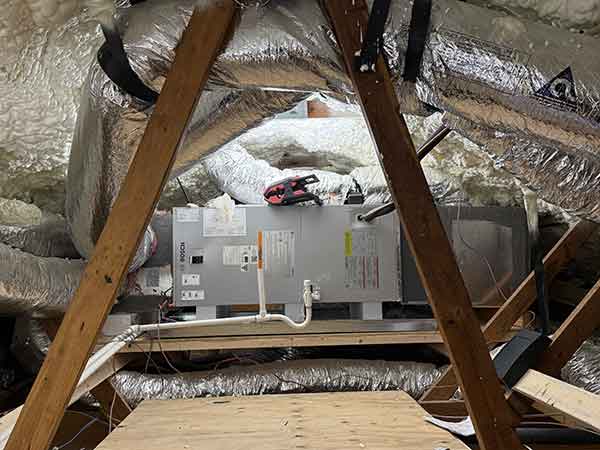
Often the equipment is fine. What is failing sits above the ceiling, in an attic that hits temperatures in August that most people would not believe if you told them, carrying air through metal and flex duct that was installed when nobody thought very hard about what an unconditioned attic does to conditioned air.
What an Attic Does to Air You Already Paid For
A Hill Country attic in late summer is a genuinely hostile place. The roof deck bakes, the space under it holds that heat, and every duct crossing it is a thin-walled pipe carrying cold air through an oven. Insulation on the duct slows that exchange down. It does not stop it. Air that leaves the coil cold arrives at the far register meaningfully warmer, and the longer the run the worse the arithmetic gets.
That is the loss you can calculate. The loss that actually breaks houses is leakage, and it is worse on the return side than the supply side. A supply leak wastes cold air into the attic, which is expensive and annoying. A return leak does something worse: it pulls superheated attic air into the system and mixes it with the air coming back from your rooms. The equipment then has to cool that mixture. You are paying to air condition your attic, one lungful at a time, and no amount of tonnage fixes it because the machine is doing exactly what it was built to do.
Why the Far Room Is Always the Loser
Air takes the easy path. In a house where the trunk runs down the middle and branches peel off along the way, the registers nearest the air handler get served generously and the run at the end of the line gets whatever is left after friction, leakage and heat gain have taken their cuts. In an older house that has been added onto, and plenty here have been, the addition often got tied into a duct system that was already at its limit.
So the back bedroom sits four degrees warm, somebody closes vents in the good rooms to force air backward, and that raises static pressure across the whole system and makes the blower work harder for less delivered air. It is a reasonable-seeming move that makes the problem worse, and we see it in half these houses.
Sealing Before Buying
The honest sequence is to fix the delivery system and then find out what size equipment the house actually needs. Done in that order, the tonnage question frequently answers itself downward. Sealing the returns, repairing the obvious disconnections, correcting crushed flex, and getting insulation values right on the runs that cross the worst of the attic will change how a house performs more reliably than another half ton of capacity.
Done in the other order, you buy a larger machine to overcome a leak you are still paying for, and now you own an oversized system pushing air through bad duct. Oversized equipment satisfies the thermostat fast, shuts off, and never runs long enough to pull humidity out of the air. The house reaches temperature and still feels clammy, which around this lake is its own complaint.
What We Look at in an Older House
The return path first, because it is the highest-leverage thing in the building. Then the trunk and the branch runs, looking for disconnections at the boot, crushed sections where somebody stored boxes on them, flex that sags into long unsupported bellies, and joints that were taped rather than mastic-sealed decades ago and have given up since. We look at where the runs sit relative to the insulation, because a duct buried in insulation lives in a much kinder world than one lying on top of it.
We also look at whether the system was ever balanced. A lot of these houses have no dampers at all, or dampers that were set once and never touched again. That is a cheap thing to correct and it sometimes resolves the whole complaint.
Where It Actually Lands
Not every older house needs its ductwork rebuilt. Some need a return sealed and a damper adjusted, and the difference shows up the same week. Some have a duct system that is genuinely at the end of its life, and no amount of patching is honest work. The point of looking first is that both of those are real outcomes and you cannot tell which one you have from the street.
What we will not do is quote you a bigger machine because it is a faster conversation. If the ducts are the problem, replacing the equipment moves your money and leaves your comfort where it was.
How can I tell whether my ducts are leaking without opening the ceiling?
The clues are usually in the pattern rather than the duct itself. A system that runs long, cannot hold the setpoint on the hottest afternoons, and delivers noticeably weaker air at the far registers is describing a delivery problem. A house that gets dusty faster than it should is often pulling attic air through return leaks. None of that is proof, but together it is enough reason to look before buying equipment.
Is it worth sealing ducts in a house we might sell in a few years?
Usually yes, because it is the cheapest comfort improvement available and it shows up on the power bill immediately rather than over a decade. It also protects you from the more expensive mistake, which is a buyer or an inspector concluding the system is undersized and you replacing it to close a sale.
Would moving the ductwork into conditioned space fix this permanently?
It is the ideal answer and it is rarely practical in an existing house. Bringing ducts inside the thermal envelope means either building soffits and chases through finished rooms or moving the insulation to the roofline, which is a significant project. For most older homes here the realistic path is sealing, repairing and insulating what is there, which recovers most of the loss for a fraction of the disruption.
My system is old anyway. Should I just replace everything at once?
If the equipment is genuinely near the end and the ducts need work, doing both together is efficient because the house is already open and the sizing can be done against the corrected delivery system. What we push back on is replacing equipment alone and calling the duct work optional, because that is the version where you spend the most and gain the least.
Do closed vents in unused rooms help?
They almost never help and they frequently hurt. Closing registers raises static pressure across the system, which makes the blower work harder while moving less air overall, and on a leaky duct system it pushes more of that air out through the leaks rather than into your rooms. Balancing with dampers at the trunk is the controlled version of what people are attempting with closed vents.
Find Out What the Ducts Are Costing You.
A measured look at the return path, the trunk and the runs that cross the attic tells you whether this is a sealing job, a repair, or a delivery system that has run out of life. The house decides, not a sales sheet.
Call (512) 925-3090or request a call backSee what the work looks like in the gallery, read how we handle repair calls in town, or start with a maintenance visit.