Caldwell County, Covered.
Caldwell County is barbecue country with a courthouse: Lockhart’s smoke-famous square, Luling’s oil-and-watermelon main street, and the ranch country between them, where the kitchens that feed the pilgrimage run commercial systems that cannot fail on a Saturday.
Caldwell County · Central Texas
Where the Kitchens Are the Famous Part
Caldwell County’s identity runs through its kitchens: Lockhart’s barbecue houses drawing lines down the square, Luling’s own smoke tradition, and the restaurant-and-hospitality economy those pilgrimages feed, which makes the county’s commercial HVAC story unusually serious for its size, makeup air fighting smoke and heat, dining rooms holding comfort against kitchen gravity, walk-ins guarding briskets by the hundredweight, and the whole restaurant doctrine earning its keep where the food is the town’s reputation.
The residential stock runs courthouse-town classic: Lockhart and Luling’s historic squares and their surrounding grids, older homes with character and retrofit puzzles, newer edges growing as the Austin orbit widens, and the ranch country between, well-and-septic properties on the 183 corridor. The county rides our southern routes with honest windows, and the commercial relationships anchor regular runs. Martindale’s river bend and Niederwald’s crossroads community fill out the roster, and the county’s position on the 130 toll corridor keeps pulling new rooftops toward its northern edge, subdivision stock arriving with the same builder-grade patterns the corridor counties know. Each town below carries its own page, written to its own grain, and the county file grows with every smoked-brisket pilgrimage that ends in a service call. The state park on the river, the courthouse itself, one of the most photographed in Texas, and the annual barbecue crowds all feed a small but genuine visitor economy whose comfort systems carry real weight for towns this size.
Plenty of calls are not a broken part at all. Ductwork leaking conditioned air into a hot attic, a return that was never sized for the equipment, a system two tons oversized that short cycles and never pulls humidity out. Those are airflow and sizing problems, and swapping a part will not touch them. Fixing them properly is duct work or a correctly sized installation, and we say which one it is before anybody spends money. The full list is on the services page.
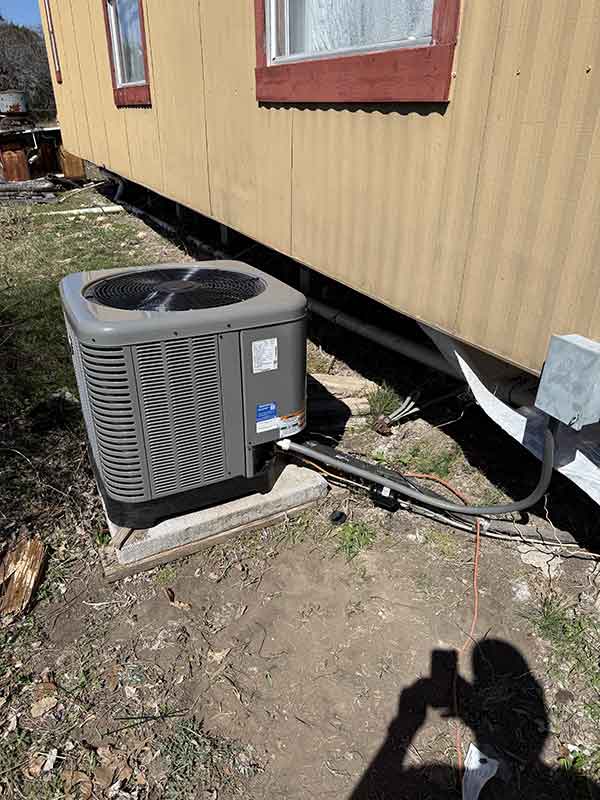
New equipment bolted to old ductwork is the most common way a good system disappoints its owner. A furnace and coil move a specific amount of air to do what the label says, and if the duct system cannot pass that air, the label is fiction. So before anybody picks a model number, the ducts get evaluated: static pressure measured across the air handler, return size compared against what the new airflow needs, the trunk and branch layout checked, the accessible runs looked at for crushes and disconnections. Plenty of changeouts out here need a bigger return or a reworked plenum more than they need a higher efficiency rating. That gets quoted as part of the job rather than discovered afterward, because the alternative is a homeowner who paid for high-end equipment and got a noisy blower, a starved coil, and the same hot back bedroom. The install process starts there for a reason.

The Local Read
What Caldwell County Runs On
Caldwell County HVAC serves a food-economy county: the barbecue and restaurant trade whose commercial systems, hood-and-makeup-air balances, kitchen-exposure equipment, product-guarding walk-ins, run the serious end of the catalog in towns this size, and whose Saturday stakes, the lines down the square, make the emergency doctrine matter; the courthouse-town residential stock, historic squares and their grids, character homes needing retrofit thinking, newer growth on the edges running corridor patterns; and the ranch country’s well-water and acreage realities along 183 and 80. The southern routes carry the county with honest windows, the commercial accounts anchor the rhythm, and the county’s chapter of the file smells faintly of oak smoke, which is exactly how it should be.
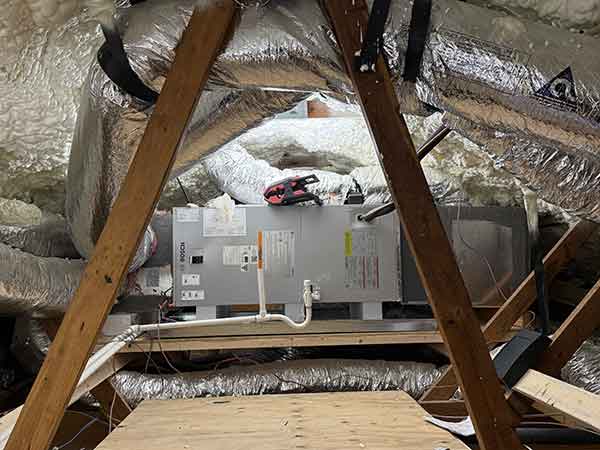
Attics out here hit a hundred and forty degrees, and in a lot of older houses that is exactly where the air handler and the ductwork live. Every foot of uninsulated duct in that oven is cooling you paid for and lost before it reached a register. Leaky boots and crushed flex make it worse. A good portion of our summer work is up a ladder fixing that, not replacing equipment.
A frozen coil looks like the strangest failure in the trade and it is usually the simplest. Somebody in Caldwell County calls because the air conditioner is blowing warm, goes and looks, and finds a block of ice on the indoor coil or frost creeping down the copper. Ice means the coil got colder than it should have, and that happens when not enough warm house air is moving across it. So the hunt is for airflow: a filter nobody changed since spring, a return grille blocked by furniture, a blower wheel packed with dust, a crushed flex duct in the attic, a closed-off damper. Low refrigerant charge freezes a coil too, which is why the charge gets weighed rather than guessed. The first instruction over the phone is always to shut the cooling off and run the fan alone so the ice melts, because nobody can diagnose a coil they cannot see.
One number covers the county.
Describe the symptom, hear the honest window, get the stocked truck. The 24-hour line answers at any hour.
Any Hour, Any Day
What the Name Actually Means
The name of the company is the promise: Off Duty means the phone answers when everyone else’s shop is closed, because HVAC failures keep contractor hours nowhere on earth. The 2 AM no-cool call with a newborn in the house, the Christmas morning heat failure, the Sunday walk-in cooler alarm with a week of product on the line, those are the calls this company was built around, and the after-hours line rings a technician, never a message tree. Triage runs honest: genuine emergencies jump the board, vulnerable households, infants, elderly, medical equipment, go first, and the merely inconvenient gets the earliest truthful slot instead of a pretend one. What the after-hours rate buys is stated on the phone before the truck moves, so the 2 AM decision is yours to make with real numbers, and plenty of callers take the free advice to limp until morning instead, which is fine by us. The emergency file across ten years says most disasters announce themselves weeks early as small noises and small bills; the maintenance rhythm exists to catch them there. But when the failure comes anyway, at whatever hour, the phone answers, and that single fact is the company’s entire founding idea.
Towns We Serve in Caldwell County
Every Community, Its Own Page
Click your town for the local page, or call and skip the reading entirely.
Lockhart · Luling · Martindale · Niederwald
Recent work from across the county is in the gallery.
The Off Duty Standard
Why Caldwell County Calls Burnet
A dispatcher who has never held a gauge cannot tell you what parts to bring. Here the person taking the call is a tech, so the truck leaves loaded for the symptom you described rather than loaded generically. That is most of why one trip finishes the job instead of three. The failure patterns come from a decade of local calls, and they sit behind every repair we run.
After hours the order of operations changes. The on-call truck is stocked with the parts that actually fail around here, and calls get triaged rather than queued: no-heat in a freeze and no-cool with elderly folks or a baby in the house go first, always. (512) 925-3090 rings a tech at two in the morning the same as at two in the afternoon. That is the whole point of the name, and the county map does not change it.
The pricing policy travels intact: numbers before work, always, and no premium for geography beyond the honest drive. When the smart move is not spending money, a settings fix, a warranty claim we can file instead, you hear it, because the long game in a small market is the only game.
Drain service is the least interesting thing on the checklist and it prevents the most expensive damage we see. A cooling system produces gallons of condensate a day, and in this humidity that water grows biofilm inside the drain line until the line narrows and stops moving. Then the pan fills. A working float switch shuts the system off and you get a no-cool call. A missing or failed float switch gets you a ceiling. So every cooling visit includes clearing the line properly rather than poking at it, flushing it, dropping in a treatment tablet that keeps the growth down between visits, pulling and cleaning the trap, and actually testing the float switch by lifting it to confirm the system shuts down. Condensate pumps, where they are used, get cleaned out too, because Hill Country water scales them up and a pump that will not pump is the same flood by a different route.
Caldwell County Questions
Asked Around the County
Do you service the restaurant equipment in barbecue country?
The restaurant doctrine runs here at full strength: makeup-air systems balanced against serious hood draw, dining comfort held against kitchen heat, kitchen-exposure equipment on the accelerated rhythms smoke and grease demand, and the cold chain guarded at brisket stakes, walk-ins whose weekend product is the town’s reputation, per the refrigeration doctrine, with the emergency line reading Saturday-service failures as exactly the events they are. The barbecue economy’s systems are commercial work with civic weight, we treat them accordingly, and the county’s kitchens anchor southern routes that the residential calls then ride efficiently.
Can you work on the older homes around the Lockhart square?
The courthouse-town stock is standing work: the square-adjacent historic homes with their character constraints, retrofit paths chosen per the building-votes doctrine, ductless where structure resists, compact systems where geometry allows, the older grids’ pier-and-beam and plaster realities respected, and the newer edge subdivisions running the corridor playbook. The county’s residential mix rewards the retrofit fluency, and the honest assessment reads each house before proposing anything, per the standing practice, the character kept while the comfort arrives.
How do your service windows work this far south?
Honestly, per the standing policy: the southern routes run Lockhart and Luling on clustered days, commercial rhythms anchoring the regularity, residential calls riding the same runs, windows quoted with the real drive from Burnet or the day’s route position, and emergency response reaching the county around the clock at truthfully-stated windows. The distance is real and never theatrical, the pricing carries no geography premium beyond the honest drive, and the county’s standing accounts keep the routes familiar, per the whole southern-map practice.
How long should a system last around here?
Central equipment in this climate generally runs twelve to eighteen years, and the spread between those two numbers is mostly maintenance and installation quality rather than brand. Our cooling season is long enough that systems here age faster than the national averages suggest, so a well-kept fifteen-year-old unit is doing fine and a neglected ten-year-old one may be done. When yours gets into that range we start talking about the replacement decision early, on your calendar, instead of in August.
Why is one room always hotter than the rest?
Almost always ductwork rather than equipment. A crushed or disconnected flex run in the attic, a branch too small for the room, a blocked return, or a boot leaking into the attic will starve one room while the rest of the house is comfortable. We measure airflow at the register and static pressure at the air handler before suggesting anything be replaced. Sealing or resizing a run is usually cheaper than any equipment work and fixes it permanently.
Caldwell County, Covered.
Straight answers, fair prices, and a truck that shows up when promised, anywhere on the county map. Send the form or call now.
(512) 925-3090 Book a Free Look