Before the New System Goes In, Check What Feeds It.
People shopping for a new air conditioner tend to think about the equipment: efficiency, the brand, maybe a quieter compressor. Very few think about the gray metal box on the garage wall. In an older Granite Shoals house, that electrical panel can decide how the whole job goes.
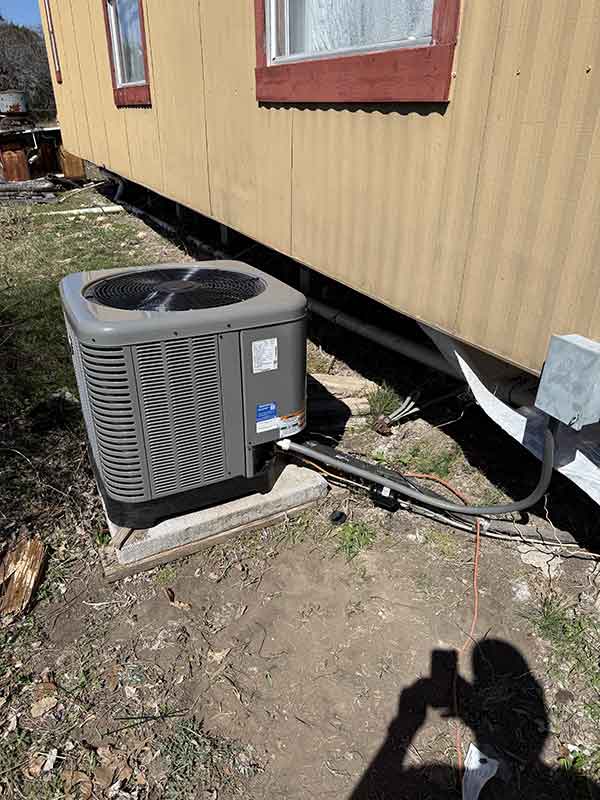
A lot of the housing here grew up in stages, and plenty of panels went in long before today’s loads existed. Checking one ahead of an install is ordinary work for us, and it heads off the kind of trouble nobody wants to discover with a new condenser sitting on the pad.
Why an Old Panel Matters for Cooling
A panel is a set of limits. It can safely deliver only so much power to the house, and each breaker protects a circuit built for a certain load. When a house was a small fishing place with a few lights and a refrigerator, those limits felt roomy.
Add a range, a water heater, a dryer, a well pump, a shop out back, and a string of window units over the decades, and the same panel can end up running near its edge. A central system, or a heat pump with electric backup heat, asks for a lot of power at once, especially at startup and on the coldest mornings when the backup strips kick on.
When a panel cannot carry that, the signs range from breakers that trip on hot afternoons to connections that run warm inside the box. Neither one belongs in a house that just got new equipment.
What We Look For First
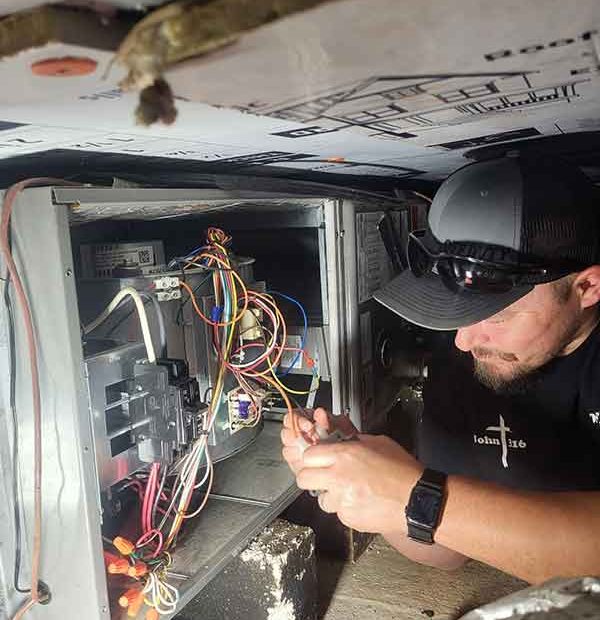
The opening question is simple: is there room? We look at the panel’s rating, how many spaces are open, and whether a correctly sized breaker for the new equipment has somewhere to land.
Then we look at what the panel already does. Doubled-up breakers, circuits tacked on by previous owners, and labels that no longer match the rooms all tell us the house outgrew its panel a piece at a time. Signs of heat, like a discolored breaker or a scorched smell near the box, jump straight to the top of the list.
The circuit that fed the old system gets checked too. Its wire and breaker have to match what the new equipment calls for on its nameplate. A replacement that steps up in size, or trades a gas furnace for a heat pump with electric backup, often needs more than the old circuit was built to give.
Layered Houses, Layered Wiring
The cottages around town that started small and grew rooms over generations left electrical history behind, right alongside the duct history. A bedroom wing might run off a subpanel someone added. A closed-in porch might share a circuit with the kitchen. Window units got plugged into whichever outlet reached.
None of that is unusual, and not all of it is a problem. It does mean the panel cannot be judged from its door alone. We trace where the big loads actually live before recommending a system, because adding central air or a multi-head ductless setup to a house like this has to account for everything already drawing power.
Pulling the window units frees some capacity, which helps. It rarely frees as much as owners hope, since those units ran on general circuits the house keeps using for lamps, fans, and chargers.
Well pumps deserve a mention of their own. Some properties in the county still draw from a well, and a pump kicking on at the same moment as a compressor stacks two heavy startup loads on the panel together. On a panel with little room to spare, that overlap is often when a breaker finally gives out, which is one more reason we ask what else in the house cycles on and off.
When the Panel Needs Work
Sometimes the answer is a new dedicated circuit and nothing more. Sometimes the panel itself needs attention, whether that means more capacity, replacing one past its useful life, or correcting earlier work. Either way, you hear it during the assessment, in plain English, along with the reasons.
Timing matters here. Electrical work belongs on the calendar ahead of install day, so the new system is not sitting in the driveway waiting on a panel. It also belongs in the written quote, so the scope is settled before anyone starts.
We would much rather tell you up front that a house needs electrical work than set equipment that trips its breaker the first August afternoon. That is the straight version of the job.
How Equipment Choice Changes the Load
What you install changes what the panel has to handle. A correctly sized system draws less than an oversized one, which is another reason the load calculation comes before any model number. Inverter-driven equipment, including the Mitsubishi ductless systems we put in as a Diamond Contractor, ramps up gradually instead of slamming on at full power every cycle.
Heat pumps need their own conversation. They carry Texas winters well, but the electric backup heat that comes on during a hard front can be one of the largest loads in the house. Sizing that backup to the house, and not simply grabbing the biggest strip kit on the shelf, keeps the panel out of trouble.
Ducts play a part as well. A system forced to push air through crushed or undersized ducts runs longer, and longer run times add up on the electrical side too. That is why the install process here starts with duct evaluation and static pressure readings.
Getting to Know Your Own Panel
Find your panel and open the small door, never the cover behind it. See whether the breakers are labeled, whether any are marked for the AC or the heat, and whether any have tripped more than once this year. Jot down which ones and roughly when.
Write down whatever you know about past work: an added subpanel, a new circuit for a shop, a generator hookup. That history saves time during an assessment and sometimes answers questions the panel itself cannot.
And if a breaker trips again right after you reset it, stop resetting it. That breaker is telling you something. To see how a full changeout runs from the first visit on, read our installation page, and look over the Granite Shoals page for the rest of our work in town.
Does every new AC install need a panel upgrade?
No. Plenty of houses have room to spare, and the new system goes on the existing circuit or on a new dedicated one. The check exists to catch the houses that do need work before install day, and it adds nothing to the job for the houses that do not.
My AC breaker trips on hot afternoons. Is that the panel or the unit?
It can be either. A weak capacitor or a compressor struggling to start will trip a healthy breaker, and a worn breaker can trip under a perfectly normal load. Measuring the unit’s amp draw against its nameplate sorts it out. If it keeps tripping, leave it off and call.
Can I switch from window units to central air on the same panel?
Sometimes. Pulling window units frees a little capacity, but central air needs its own properly sized circuit. Whether the existing panel can take that depends on its rating, the open spaces, and whatever else the house runs, like a well pump or a shop.
Is a ductless system easier on an older panel?
Often it draws less than a larger central system, because inverter equipment ramps up gradually and each head only conditions its own space. It still needs a dedicated circuit, and a multi-head setup has to be sized honestly. The load calculation tells us what the house truly needs.
Why can’t the new system just use the old wiring?
Sometimes it can. The wire and breaker feeding the old system were sized for that equipment. If the new unit calls for the same or less on its nameplate and the wiring is in good condition, it stays. If the new system is larger or the wire shows heat damage, it has to change.
Your Panel Gets a Free Look Before You Choose a System.
We check the panel, the circuit, the ducts, and the load, then walk you through exactly what a new system will ask of your house.
Call (512) 925-3090or request a call backPast installs are in the gallery. If a tripped breaker already left you without cooling, emergency service answers around the clock.