Meadowlakes Ducts Leaking Cold? Test, Then Seal.
When ductwork runs through an attic, the hottest place on the property, every leak in it either spills cooled air into that heat or pulls attic air back into the rooms. Off Duty measures the leakage in Meadowlakes homes first, seals the joints that are actually losing air, repairs crushed and disconnected runs, and tests again so you can see what changed. The house stays as tidy as you keep it, and the price is set by what the test finds.
Ductwork
Where the Paid-For Air Goes
Supply leaks are the obvious loss. Air you paid to cool escapes into the attic before it reaches a bedroom, so the system runs longer, the far rooms stay warm, and the electric bill reflects air nobody ever felt.
Return leaks are the quieter problem, and in a lake town they may be the bigger one. A return duct is under suction, so any gap draws in whatever surrounds it. In an attic that means superheated air and insulation dust. Here, with Lake Marble Falls on one side and the irrigated green of the fairways keeping the air damper than open country, it also means extra moisture the system then has to wring back out. That shows up as rooms that feel sticky at a setting that ought to be comfortable.
The return gaps closest to the air handler pull hardest of all, so a small opening at the return plenum can draw in more attic air than a bigger one far down the line.
A spray-foamed roof deck changes the picture without solving it. The ducts then sit in an attic that stays closer to room temperature, which helps, though a leak there still moves air where it was never meant to go and can still pull dust off the attic floor.
“They’re very informative and quick to help.”
Brian C., customer review
Informative is the part we take seriously on a duct job, because the test numbers belong to you. Precise households here tend to notice the symptoms early: filters loading fast even when changed on schedule, dust settling sooner than it should, one room that never matches the thermostat. Each of those can trace back to the ducts instead of the equipment.


Measure the Leak Before Sealing Anything
Sealing ducts without testing them is guesswork with a brush in hand. A duct leakage test pressurizes the system and measures how much air it loses, which tells us whether sealing is worth doing at all, where to look first, and what a good result should read afterward.
The test itself is quiet work. Registers get temporarily covered, a calibrated fan connects to the duct system, and the reading takes shape while you go about your day. Nothing in the living space gets taken apart.
The test belongs ahead of any equipment decision too. Ducts get evaluated before a new system is chosen, because leaky or undersized ductwork can make the right machine perform like the wrong one, and adding tonnage never fixes air that fails to arrive.
When the numbers come back, you see them. If the system tests tight, we say so and you skip the work. If it leaks, you get a written scope of what we will seal and repair, and a fixed price for it.
Name the Room That Never Cools.
Describe the rooms that never cool and when the dust shows up. Somebody answers the phone at any hour.
Mastic Where the Air Escapes
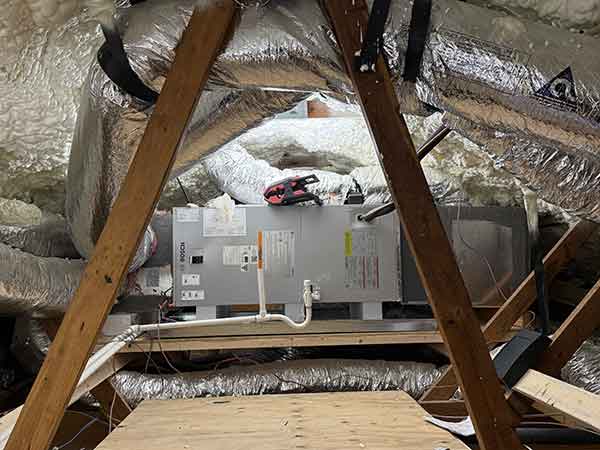
Tape is where most duct sealing goes wrong. Cloth duct tape dries out and lets go in attic heat, and even good foil tape depends on a clean surface it seldom gets. On the joints that count, we brush on mastic and embed fiberglass mesh wherever a gap needs bridging.
The leaks cluster in predictable places: the boots where ducts meet ceiling registers, the collars where runs leave the plenum, the takeoffs along a trunk line, and the connections where flex duct slides over metal and gets cinched with a strap. Those come first because that is where the air goes. At the registers themselves, the gap between the boot and the drywall gets closed as well, since it is a straight path from the attic into the room.
Then the runs themselves. Flex duct gets kinked around framing, flattened by someone crawling through on another trade’s job, or pulled loose from its collar entirely, and a disconnected run can pour cooled air into the attic for years without anyone noticing. Those runs get straightened, reconnected and sealed. A section too damaged to save gets replaced, and you hear about it before we do it. Where a duct’s insulation jacket has torn or slid away, the run still gains heat and can sweat, so damaged jackets get closed up or replaced alongside the seal.
Support matters as much as sealing. Flex that sags between hangers loses airflow at every dip, so runs get pulled reasonably straight and hung properly, and loose boots get fastened to the framing so each register sits tight to the drywall. Want to ask about your layout first? Write to us.
Diamond Contractor
A Mitsubishi Diamond credential.
Second Generation
Raised in the trade, ten years on the tools.
Owner on the Truck
The owner runs the test and the sealing.
Open 24 Hours
The phone is answered around the clock.
Clean Work in a Clean House
Duct work has a reputation for leaving a mess behind. It does not have to. Nearly all of the job happens overhead, and the part that touches the living space gets handled like this.
- The path gets protectedFloor coverings go down from the door to the attic access before tools and materials come inside.
- Registers get coveredSupply and return grilles are covered while sealing happens overhead, so stirred-up dust stays out of the rooms.
- Debris leaves with usOld tape, damaged duct sections and packaging go out on the truck, never into your trash bins.
- Retest, then walkthroughThe leakage test runs again after sealing, and you see the before and after readings side by side.
If the attic shows us something outside the duct job, like a sagging drain line or a wire nobody secured, you hear about it in that same walkthrough. We note it, show you, and leave the decision with you.
Sealing pays off quietly. The system runs shorter cycles to hold the same setpoint, the far rooms catch up with the near ones, and the filter stops loading so fast. A tight duct system is something nobody in the house notices, and that is exactly how it should feel.
The price for sealing is fixed before work begins, based on what the test found, and it does not grow once we are in the attic. Earlier attic jobs are in the gallery, and the countywide version of this service is described on air duct sealing.
Duct Sealing, Asked and Answered
What homeowners want to know before anyone opens the attic hatch.
How do I know if my ducts are leaking?
Rooms that never match the thermostat, dust that returns quickly, high bills and air that feels damp at a cool setting all point that way, though only a test proves it. A leakage test pressurizes the ductwork and measures the loss, so we seal what is leaking and skip what is not.
Why mastic instead of tape?
Mastic bonds to the joint and stays flexible through attic heat, while cloth duct tape dries out and lets go. Foil tape has its place on clean metal, but at boots, collars, takeoffs and flex connections, brushed mastic with mesh where needed is what holds up over the long run.
Can return duct leaks really make my house feel humid?
They can. A return runs under suction, so any gap pulls in the surrounding air. In an attic that air is hot and dusty, and around the lake it carries extra moisture. The system then has to remove that water as well, which can leave rooms feeling sticky at a normal setting.
Should I seal ducts before replacing my AC?
Test them first, at minimum. Ductwork gets evaluated before any equipment is chosen, because a leaky or undersized system can make a correctly sized unit perform poorly. Sometimes sealing changes the size a house needs, and that is far better to learn before buying equipment than after.
Will duct sealing make a mess in my house?
Very little. Most of the work happens in the attic, and we protect the path to the access, cover registers while sealing and carry out every scrap of old tape and damaged duct. When we finish, the rooms look the way they did when we arrived that morning.
What if a duct run is crushed or disconnected?
We repair it as part of the job. Kinked flex gets straightened and supported, crushed sections get replaced, and runs that have pulled off their collars get reconnected and sealed. A disconnected run can dump cooled air into the attic for years, so finding one often makes the biggest difference.
Sealed ducts make every other part of the system work better. A tight duct system pairs well with whole-home dehumidifier installation in damp houses, and it belongs in the plan ahead of AC replacement or a new air handler installation. A coil losing charge goes to refrigerant leak repair, and the rest of our town coverage lives on our Meadowlakes page.
Find Out What the Ducts Are Losing
Tell us which rooms run warm, how quickly the dust comes back and whether the system is new or old. The free look starts with that call, and the leakage test tells us the rest. Most households already know which room bothers them most, and that is usually the best place for us to start looking. Prefer to write it down? The contact form works too.
(512) 925-3090 Book the Free Look