
Meadowlakes Air Handlers, Set Right in the Attic.
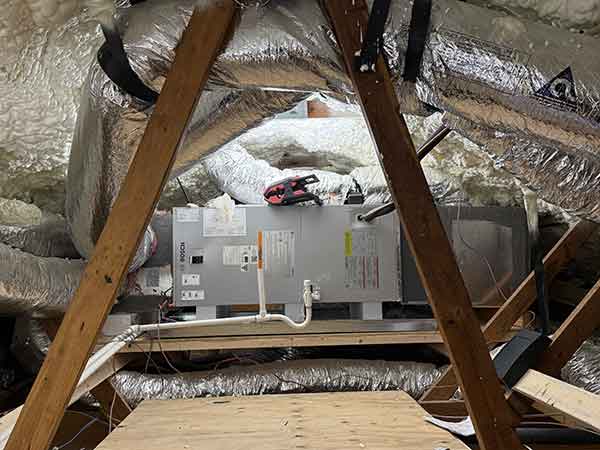
The condenser out by the driveway gets the attention, but the half up in the attic moves every cubic foot of air your family breathes. Off Duty installs air handlers in Meadowlakes homes with the platform, drain protection, blower and return built around the house, and matched to the outdoor unit it works with. The owner sets the equipment, measures airflow at your registers, and walks you through the numbers before the job closes out.
Attic
Everything Under the Cabinet Counts
An air handler in an attic is a water appliance almost as much as an air appliance. Its coil pulls moisture out of the house all season, and with Lake Marble Falls next door and green, irrigated landscape all around, that adds up to a lot of water heading for a drain.
So the base gets built first. The unit sits on a solid, level platform with enough room around it for a technician to work. A secondary drain pan goes underneath, fitted with a float switch that shuts the system down before an overflow can reach a ceiling. The primary condensate line gets pitched and routed to a termination the code allows, and the secondary gets a separate path so a clog shows itself before it stains drywall.
Access matters as well. A unit wedged behind framing, or reached by crawling over loose insulation, gets skipped at maintenance time, and a skipped coil and drain are where trouble starts. We leave a clear path to it and a service side that opens fully.
None of that shows in the living room. All of it shows the first time a drain line clogs on a sticky July night, which in this county happens about as reliably as the heat itself.
“We love Bryce… He was able to find the issue immediately and get everything fixed quickly.”
Lacey S., customer review
Fast answers on a service call usually trace back to an install that left a tech room to see, reach and test everything. That is the standard we build to when we set a new unit.

A Coil That Belongs With Its Condenser
The coil and air handler have to match the outdoor unit they serve, in capacity and in refrigerant, and the pairing should be one the manufacturer actually rates together. A mismatched coil can leave a good condenser short of the efficiency it was bought for and make the compressor work harder than its design intends.
The line set, the metering device and the refrigerant charge all follow from that match. When a Meadowlakes project includes both halves, the full AC replacement sizes them together from a fresh Manual J load calculation. When only the indoor side is failing, we check that the existing condenser has the life left and the compatibility to justify a new air handler behind it, and we say so plainly when it does not.
We also look at what the old installation left behind. Abandoned drain lines, a platform that has started to sag, and wiring spliced together in the attic heat all get sorted before the new unit goes in, so the next technician up the ladder finds a clean install.
The Attic Unit Tells on Itself. Call and Describe It.
Odd noises, weak airflow or water near the attic hatch each tell us something. The phone is answered day and night.

PSC or Variable Speed, and Why Attics Cook Both
The blower is the choice that shapes how the house feels day to day. A PSC motor runs at a fixed speed. It is simple, proven and cheaper to replace, though it runs warm and moves the same volume of air whether the house needs a lot or a little.
A variable-speed ECM blower ramps up gently, runs longer at lower speeds, and does a better job of drying the air on mild spring and fall days, which counts for something in a lake town. Whichever motor you choose, its speed gets set to the coil and the ductwork during commissioning, instead of being left wherever the factory shipped it.
Attic heat is hard on both. PSC motors overheat, trip on their thermal protection, slow down or lock up with a screeching bearing. ECM motors fail another way, because the motor and the electronics driving it are paired, so when attic heat or a power surge kills the module, the motor goes down with it. Control boards tend to quit the same quiet way after a lightning season.
That season is worth planning around. Surge protection at the equipment does not make a board indestructible, though it gives the electronics a better chance, and we can talk through whether it makes sense for your setup.
We weigh the two honestly for your attic and how you use the rooms. When an existing blower is the part failing, air handler repair reads voltages and fault codes before anyone orders a part. Questions about a specific model? Ask through the contact page.
Diamond Contractor
Certified on Mitsubishi ductless systems.
Second Generation
A family trade, with ten years of experience.
Owner on the Truck
The owner handles your install.
Open 24 Hours
Calls taken day and night.
Returns, Filters and Air You Can Measure
An undersized return will choke even an excellent blower, and it is the most common reason a new air handler sounds loud and cools poorly. The return side gets sized to the air the blower actually needs to pull, with a grille and duct large enough to feed it quietly. If the house never had enough return, this is the moment to fix it. Placement matters too, since a single grille tucked into a room with its door closed cannot feed the whole house.
Connections at the cabinet get the same scrutiny. The supply plenum and the return drop are where an attic install most often leaks, so those joints are sealed with mastic before any insulation goes back over them. Anything farther down the duct run that looks suspect goes on the list we hand you.
The filter cabinet follows the same reasoning. A filter’s first job is protecting the coil and blower wheel from dust, and cleaner breathing comes second. The thickest high-MERV filter on the shelf, dropped into ducts that were never built for it, chokes airflow even when brand new, so we match the cabinet and the filter rating to the ducts and tell you how often to check it. Through cedar season, the honest answer is monthly. And if a whole-home dehumidifier or air cleaner might join the system later, we leave room for it on the return side now.
After the set, airflow gets measured at the registers, the temperature split is taken across the coil, amps are read on the blower, and the drain gets a water test. You see the readings, and the fixed price you agreed to is the price on the invoice.
The commissioning numbers go straight into your file. Finished attic installs are in the gallery, and the countywide picture of this service is on air handler installation.
Air Handler Questions, Answered Plainly
The ones that come up while we are standing in the hallway under the attic hatch.
Where does a new air handler go in my house?
Usually where the old one sat, often in the attic, unless that spot causes trouble for service, drainage or duct runs. We look at the platform, the clearance around the cabinet and where condensate can drain properly. If a better location exists, we explain the tradeoffs before anything moves.
Do I need a drain pan under an attic air handler?
In an attic, yes. A secondary pan with a float switch is what stands between a clogged drain line and a stained ceiling. Humid seasons near the lake grow algae in condensate lines, so the pan and switch come standard on every attic install we do.
Is a variable-speed blower worth it?
For many homes here it is, because it runs longer at low speed, stays quieter and removes more moisture on mild days. A PSC blower is simpler and cheaper to replace. We compare both for your house, your attic conditions and how you use the rooms, and then you choose.
Can a new air handler work with my existing outdoor unit?
Sometimes. The two halves have to match in capacity and refrigerant, and the condenser needs enough life left to justify the pairing. We check the nameplates, the refrigerant type and the condition of the outdoor unit, then tell you plainly whether a fully matched system makes more sense.
How do you know the installation is working correctly?
We measure it. Airflow gets read at the registers, the temperature split is checked across the coil, voltage and amps are taken on the blower, and the drain gets tested with water. You see every number, and the job is not finished until they line up with the spec.
Why would a new air handler be louder than the old one?
Usually the return. A blower pulling through an undersized grille or duct whistles and roars, and a filter too restrictive for the ducts makes it worse. We size the return to the blower and match the filter to the system, so a properly installed air handler should run quieter than the one it replaced.
An air handler lives inside a bigger system. Leaky ductwork behind it goes to air duct sealing, air that stays damp no matter the setting to a whole-home dehumidifier, and a coil losing charge to refrigerant leak repair. The rest of what we do in town is on our Meadowlakes page.
Get the Attic Half Right
Tell us what is up there now, the brand or age if you know them, and what the house is doing: noise, weak air, water near the hatch. That conversation is where a free look starts, and it often narrows the job before anyone climbs the ladder. Rather type it out? Use the contact form.
(512) 925-3090 Request a Call Back




