Cottonwood Shores AC Shut Off With a Full Pan? Clear the Line.
Every hour the air conditioner runs, the indoor coil pulls water out of the house air and sends it down a small pipe to daylight. With a lake on either side of town, that pipe also turns into a home for slime. Off Duty cleans AC drain lines in Cottonwood Shores from one end to the other: the blockage pulled, the trap opened, the pan treated, the float switch lifted by hand to prove it kills the system, and a cleanout fitted where the line has none.
Condensate
Water the System Makes on Its Own
On a long August afternoon the system can run for hours without a break, and every one of those hours sends water toward the pan under the indoor coil. Where that water goes next depends on the house. Some lines leave through a wall beside the condenser, some tie into a plumbing drain, and some lift through a small pump first. Knowing which one your house has is the first thing we sort out.
The air here stays heavy with moisture for much of the year, so the coil spends long stretches of the cooling season working as a dehumidifier and the drain carries a lot of water. That water is warm, slow and full of whatever the coil caught, which makes the inside of the pipe a comfortable place for a slick film of bacteria and algae to settle in. The film traps dust, the dust feeds more film, and the opening gets a little smaller each month.
None of it shows from the living room. The thermostat reads normal and cold air keeps coming out of the vents right up until the water has nowhere left to go.
“We love Bryce… He was able to find the issue immediately and get everything fixed quickly.”
Lacey S., customer review
Finding it fast mostly comes down to knowing where to look first. When a system in this town quits on a muggy afternoon, the drain pan is one of the first covers we pull.

From Slow Drain to Shut-Down System
The failure runs in a predictable order. The line slows, water backs up into the pan faster than it can leave, and the level climbs toward the rim. What happens next depends on one inexpensive part.
If the system has a float switch and that switch works, the rising water lifts the float, the switch opens the low-voltage circuit, and the outdoor unit goes quiet. The house warms up and you call about the air conditioning. That is the good version of this story, because the water stayed in the pan.
If there is no switch, or the float is glued down by its own sludge, the pan keeps filling. In an attic, the overflow lands in the secondary pan if one exists, then on the platform, then in the drywall. In a hall closet or a manufactured home cabinet, it reaches the floor. Either way, a stain is often the first sign, and by the time it appears the line has usually been half blocked for a while.
When we find a tripped float switch, the cause gets cleared before anything is reset. Restarting a system with the line still plugged just fills the pan again and puts the same water back on the switch.
Unit Quit and the Pan Is Full?
Turn the thermostat off and call. Someone answers at any hour and can tell you what to check in the meantime.

Proving the Float Switch Works
A float switch is wired into the thermostat circuit, and one that nobody has tested is one nobody should trust. They stick. Their wires get pinched when a panel goes back on crooked. Some were mounted years ago and never connected at all.
So the test is physical. With the system running, we lift the float by hand, or raise the water level in the pan, and confirm the outdoor unit shuts down. Then we let it drop and confirm the system starts back up. If it fails to cut out, the wiring gets traced through the cabinet until we know why, and a dead switch gets replaced before we leave it in charge of your ceiling.
Where an air handler sits over a finished ceiling, the secondary pan underneath gets a look too. It should be level and dry, and either drained to a spot where you would notice water or fitted with its own switch. A secondary pan holding standing water tells us the main drain has already overflowed at least once.
None of this takes long, and it is the difference between a warm afternoon and a ceiling repair.
Mitsubishi Diamond
The Diamond Contractor credential.
Learned at Home
A second-generation HVAC company.
Owner-Operated
Bryce is on the truck.
Day or Night
Open twenty-four hours.
Pumps, Hard Water and a Cleanout for Next Time
Clearing the line is the core of the visit, and it follows a set order so nothing gets skipped.
- The line, open end to endThe blockage comes out from the cleanout or the outside end, then clean water runs through until it flows freely where the line exits. Blowing air through a slimed line alone tends to leave the film behind.
- The trap, taken apartThe trap near the cabinet holds the thickest sludge in the whole run, so it gets opened and cleaned instead of flushed past.
- The pan, treatedA treatment tablet goes into the pan to slow new growth between visits.
- The pump, descaledWhere a condensate pump lifts the water, the reservoir, float and check valve get cleaned, because Hill Country water leaves scale that keeps a pump from sensing or pushing.
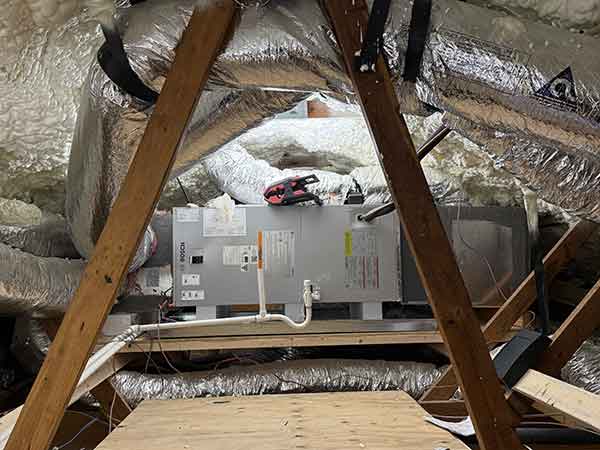
Last comes the cleanout. If the line has no tee with a removable cap near the air handler, we add one, so next season’s service starts there instead of with a cut pipe. The white drain in the attic photo near the top of this page has exactly that tee where it leaves the cabinet, which is what a line built for upkeep looks like.
What we found and what we did gets written down for you. Photos from past jobs are in the gallery, and the general version of this service is described on our AC drain line cleaning page.
What People Ask About Condensate Drains
Short answers to what comes up on drain calls around town.
Why did my AC stop cooling when the drain pan filled?
That shutdown was the float switch protecting the ceiling. When water rises in the pan, the switch opens the control circuit and stops the system before the pan spills over. Resetting it without clearing the line only lets the pan refill, so the blockage has to come out before the system runs again.
How do I know if my condensate line is clogged?
Water standing in the pan, a damp spot near the air handler, no drip at the outside end on a humid day, or a system that shuts off and will not restart are the usual signs. A musty smell near the indoor unit can point to a slow drain as well.
Should there ever be water in the secondary pan?
No. The secondary pan is a backup that should sit level and dry. Standing water in it means the main drain has already overflowed at least once, so the line, the primary pan and the switch all get checked before the system goes back to normal duty.
What does a float switch actually protect?
Your ceiling, your floor and the cabinet around the air handler. It sits in the pan or on the line and shuts the system off when water backs up. Without one, or with one stuck in place, an overflow can keep going until somebody notices a stain or a puddle.
Why does my condensate pump keep failing?
Hard water and slime are the usual reasons. Scale and film build up in the reservoir and on the float, so the pump either cannot sense the water or cannot push it out. Cleaning the reservoir and check valve often brings it back, and a worn pump gets replaced.
What is a cleanout tee, and do I need one?
It is a fitting with a removable cap on the drain line close to the indoor unit. It gives a clean entry point for flushing the line, so future cleanings go quicker and nobody has to cut the pipe. If your line lacks one, we can add it during the visit.
A drain call often turns up a neighbor problem. A coil that stays wet and fouled is a job for evaporator coil repair, and a ceiling stain under a supply register may be a sweating duct instead, which is what duct insulation fixes. An outdoor unit that hums without starting usually calls for AC capacitor replacement, and new equipment for a house on an open lot begins with split system installation. The rest of our town coverage is on the Cottonwood Shores page.
Keep the Water Moving Out of the House
If the system shut itself off, the pan is full, or a spot has turned up on a ceiling, call and describe it. If nothing has gone wrong yet, that is the easiest time to have the line cleaned, since a drain cleared before the hottest stretch of summer never gets the chance to back up. A free look covers the pan, the line and the switch, and you hear the findings and the options before any work starts. Rather write it out? Send a note through the contact form.
(512) 925-3090 Ask for a Free Look