
Cottonwood Shores Evaporator Coil Leaking? Find It Before Deciding.
The indoor coil in a Cottonwood Shores house spends most of the year soaking wet, pulling lake humidity out of the air, and that steady moisture is part of why coils leak, ice up and grow things. Off Duty locates a leak with an electronic detector and a nitrogen pressure test, separates a coil frozen by poor airflow from one frozen by low charge, and then sets repair and replacement side by side so you choose with the facts in hand.
Coils
A Coil Built to Sweat, in a Town That Never Dries Out
An evaporator coil is supposed to be wet. Refrigerant runs cold through its copper tubing, house air crosses the aluminum fins, and the moisture in that air condenses and drips into a pan below. Between Lake Marble Falls and Lake LBJ, that process barely pauses, because the humidity here hangs around almost all year.
All that water is useful work until something goes sideways. Fins packed with dust hold moisture and feed a slimy film of growth. A slow refrigerant leak drops the coil temperature until frost forms on it. A cabinet without good insulation sweats on its outside skin, and that water ends up somewhere it was never meant to go.
“Brice did a fantastic job. He didn’t stop until he found the problem with my ac unit.”
Wayne W., customer review
Coil leaks reward exactly that kind of stubbornness. A pinhole can sit buried inside the fins where no gauge points straight at it, and finding it takes patience, the right instruments and a willingness to keep looking after the easy checks come back clean.


Repair Paths, Set Side by Side
Once the leak is located, the decision belongs to you. Here is how the choices usually line up, and each one comes with its own price before any work starts.
Where the leak can be seen, you get shown the spot, along with the gauge readings that led there. Where it hides inside the fins, you see the pressure test hold or fall. Either way, nobody asks you to take a coil diagnosis on faith.
Braze the leak
A leak at a return bend, a distributor tube or an accessible joint can often be brazed shut. The repair is pressure tested, evacuated and recharged before anyone calls it finished.
Replace the coil
Formicary corrosion leaves clusters of pinholes through the tubing wall, often deep inside the fins. Brazing one spot tends to expose the next, so a matched replacement coil is usually the honest fix.
Patch for the season
On an older system with a bigger decision ahead, a smaller repair that carries you to cooler weather can make sense. We say plainly what that trade involves before you choose it.
Talk about the system
When the outdoor unit is old, or runs on R-22, pairing it with a brand new coil may be poor money. That conversation only happens when the readings point there.
Ice on the Copper Lines? Leave It Off and Phone Us.
Running a frozen system makes things worse. Switch the thermostat to fan only or off, and the person who answers can help you work out the next step, at any hour.
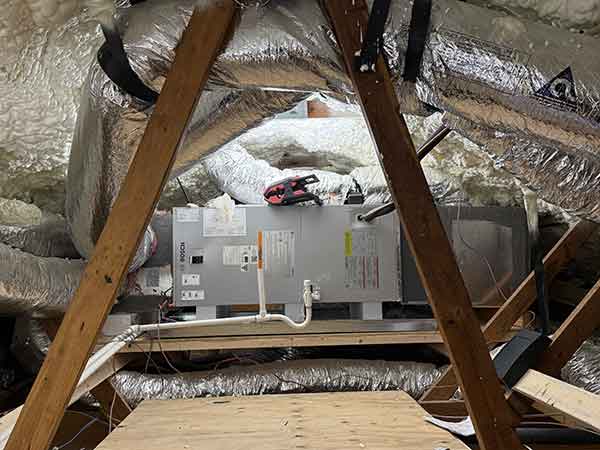
Closet Cabinet or Attic Platform
Where the coil sits changes the job. In many manufactured homes the air handler or furnace stands in a closet with the coil inside it, clearances are tight, and the supply air drops into ducts beneath the floor. Parts and access differ from site-built stock, and we treat that as its own kind of work rather than an afterthought.
Site-built houses on the original plats and the newer builds more often carry the coil on a horizontal unit up in the attic, resting on a platform with a condensate line leaving the cabinet. Attic heat bakes that cabinet all summer while its insides run cold, which is right where outside sweating begins. Some newer homes have spray-foam sealed attics that keep the cabinet in milder air.
A cabinet that drips on its outside skin is a different problem from a coil that leaks refrigerant, though homeowners usually find both the same way: a stain on the ceiling or a puddle in the closet. The cure for outside sweating is sealing the cabinet seams and replacing torn or missing insulation on the casing and the connections, and it gets checked on every coil visit.
Either way, a coil job includes the drain pan, the trap and the line, since a leaking coil and a backed-up pan often turn up together. For the broader picture of this service across the county, see the evaporator coil repair page.
Diamond Contractor
Mitsubishi certified for ductless systems.
Second Generation
Two generations, ten years hands-on.
Owner on the Truck
Bryce runs the leak search himself.
Open 24 Hours
Nights and holidays, the phone gets answered.
Frozen Coil: Airflow or Charge?
Ice on the coil and the suction line is a symptom with two common causes, and they call for opposite fixes. Adding refrigerant to a system starved for air overcharges it. Cleaning the blower on a system that is short on charge leaves the leak exactly where it was.
So the coil thaws first, with the fan running and the compressor off, and then the readings sort it out. Static pressure across the system plus a look at the filter, blower wheel and coil face tell us about airflow. Superheat and subcooling tell us about charge. The temperature split at the registers ties the two together.
When the charge reads low, the next question is where it went, because refrigerant does not get used up. That is when the electronic detector comes out. If the detector cannot pin it down, the refrigerant is recovered, the coil gets pressurized with dry nitrogen, and a gauge is watched for a drop. A falling needle confirms the leak is in that section. Nobody replaces a coil on a hunch.
A repair is proven the same careful way it was found. After brazing, the coil holds nitrogen pressure on the gauge before the system is evacuated with a vacuum pump, and only then does refrigerant go back in, measured into the system instead of topped off by feel. Superheat, subcooling and the split get read once more under load, and those numbers are written down for you.
Coil cleaning belongs in the same conversation. A coil matted with dust and biological growth restricts air, holds water and can smell musty when the system kicks on, and lake humidity keeps feeding that growth. Cleaning it properly restores airflow without flattening the fins.
You can see coil and attic work in our gallery, or tell us what the system has been doing and we will take it from there.
What Coil Owners Ask Before We Arrive
Most of these come up on the very first phone call.
What is formicary corrosion?
It is a type of corrosion that eats tiny tunnels through copper tubing, often from acids that form when household chemicals and moisture meet the coil. The leaks are pinhole-sized and frequently clustered, which is why they are hard to find and why brazing one rarely ends the problem.
How do you find a coil leak?
An electronic leak detector comes first, worked slowly across the coil and its joints. If it cannot locate the leak, the refrigerant is recovered, the coil is pressurized with dry nitrogen and the gauge is watched for a drop. Bubble solution then helps pin the exact spot on accessible sections.
Can a leaking evaporator coil be repaired?
Sometimes. A leak at a bend, a joint or a distributor tube can often be brazed and tested. Corrosion spread through the tubing usually cannot be fixed for long, and a new coil makes more sense. You see where the leak is and the price of each option, then decide.
Why does my coil keep freezing?
Usually one of two reasons: not enough air moving across it, or not enough refrigerant inside it. A clogged filter, dirty coil or blower problem starves the airflow, while a leak lowers the charge. The readings tell them apart after the ice melts, and only then does anything get replaced.
Should I just keep adding refrigerant?
We would advise against it. Refrigerant does not wear out, so a system that keeps needing more has a leak somewhere. Recharging without finding it means paying every summer while the compressor runs on the wrong charge between visits. Locating the leak once is the better use of your money.
Does a new coil have to match the outdoor unit?
It should. Capacity and refrigerant metering on the indoor coil have to suit the condenser outside, or the system loses efficiency and the compressor works harder than intended. When a new coil goes in, we choose one rated to run with the condenser you already have, and tell you if none fits.
Coil trouble rarely travels alone. A pan that keeps backing up points to AC drain line cleaning, an outdoor unit that hums without starting may need AC capacitor replacement, ducts dripping in the attic call for duct insulation, and a system too old to justify a new coil leads to split system installation. Everything else in town is on our Cottonwood Shores page.
Find the Leak Before Another Recharge
If the system has needed refrigerant more than once, the leak is still in there, and each recharge only postpones the answer. Tell us when it was last charged, whether you have spotted ice or water around the indoor unit, and where that unit sits, and the free look begins with a real leak search. To skip the phone entirely, ask for a call back here.
(512) 925-3090 Set Up a Free Look




