Georgetown’s On-Call Shop.
Georgetown runs three towns at once: the most beautiful courthouse square in Texas ringed by historic homes, Sun City’s enormous retirement community with its own service expectations, and boom-era subdivisions sprinting north and west. All three are standing territory.
Georgetown · Williamson County
Square, Sun City, and Subdivisions
Georgetown’s three housing worlds each demand their own fluency: the historic district around the square carries Victorian and craftsman-era homes whose retrofit work must respect plaster, proportion, and preservation sensibilities, ductless zones and compact systems threaded through unwilling structures; Sun City’s thousands of homes run consistent stock aging on a predictable curve, with households who value punctuality, clear explanation, and documented work above all; and the growth rings, from Wolf Ranch westward, run the production-builder fleet with its known calendar. We serve all three on the same weekly routes, and the file on each keeps deepening.
The San Gabriel River’s forks thread the city with the green corridors that make it livable, Southwestern University anchors the east side with its own rental economy, and the square’s restaurants and shops carry a commercial layer whose systems work business hours. Sun City deserves its own sentence: a community of that scale replaces systems constantly as its stock ages, and the replacement counsel there runs especially honest, right-sized equipment, unhurried installs, paperwork handled cleanly, because a retirement community has seen every sales tactic and deserves none of them.
Residential or commercial, the roster holds: cooling repair stocked for same-visit fixes, heat pump installs running the two-season math, garage and casita mini-splits, duct repair for the attic archaeology every house here accumulates, humidity work for the lake air, honest inspections for the buying and selling, and rooftop units for the storefronts. The full catalog lists all 147.
Year nine is where the decision gets hard, and it deserves real arithmetic rather than a sales instinct. Put the repair cost on one side. On the other side put how much life the repair honestly buys, what the system costs to run compared with current equipment, whether it uses a refrigerant that is being phased down and priced accordingly, and whether any warranty is still standing. A compressor on a nine-year-old system is a different conversation than a capacitor on a nine-year-old system, and a coil leak on an R-22 machine is a different conversation again. Sometimes the repair is clearly right and we do it. Sometimes the repair is money poured into a system that will ask for more next August, and saying so is the job. What nobody should get is a replacement pitch with the numbers withheld, because that is what happens when the math will not support the recommendation.


The Williamson County Context
What Corridor Systems Inherit
Williamson County HVAC is boom-construction HVAC: the fastest-built housing stock in Central Texas, systems sized by production habit rather than Manual J, ducts run to schedule rather than design, and the county’s repair calendar reads like the consequences, year-five capacitor season, starved returns behind every master suite door, upstairs zones that never worked, builder-grade equipment reaching its early end while the mortgage is young. The corridor also carries real advantages, newer electrical, accessible attics, equipment generations young enough to service well, and the corrections, duct sealing, return additions, honest right-sizing at replacement, transform these houses more dramatically than anywhere else we work. The 183/29/79 routes make the county a daily run from Burnet, and the corridor’s subdivisions are the file’s thickest chapters.
The service calendar here follows the Hill Country’s seasons: spring tune-ups timed after the live oak pollen dump, summer emergency capacity staffed for the hundred-degree stretches that find every weak capacitor in the county, fall heating checks ahead of the first blue norther, and winter freeze responses for the heat pumps and pipes the hard snaps test. Seasonal maintenance keeps the whole cycle boring, which is the goal.
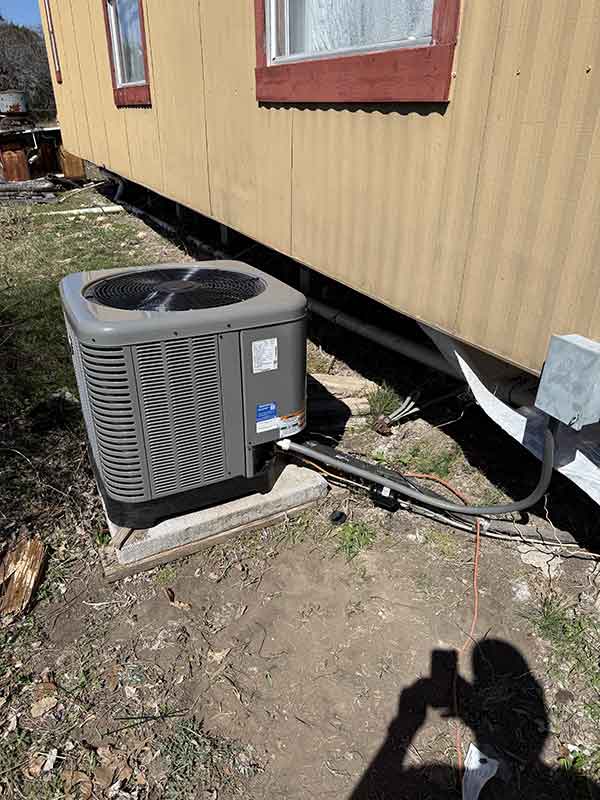
One part fails more often than everything else combined, and it costs less than a tank of diesel. The run capacitor is a little cylinder that gives the compressor and the fan motor the shove they need to start turning. Heat kills it, and an outdoor unit sitting in full Texas sun for five months is exactly the wrong place to ask a capacitor to live. The symptom most Georgetown callers describe is the same: the outside fan is not spinning, or it hums and quits, or the house cools fine until the hottest hour and then gives up. A tech reads the capacitor with a meter, sees it has drifted well below its rated microfarads, and swaps it. Ten minutes, one part, and the system runs. Its cousin the contactor, the electrical switch that closes every time the thermostat calls, pits and welds from the same duty cycle. Both ride every truck.
One number, any hour.
No answering service, no callback queue. The person who picks up can diagnose over the phone.
Any Hour, Any Day
What the Name Actually Means
There is a difference between a 24-hour phone number and 24-hour service, and most homeowners only discover it at the worst possible moment. A lot of outfits route after-hours calls to an answering service, which is a polite stranger with a script and a message pad who cannot tell you anything about your system and cannot send anyone. You get a call back when the office opens. Our line reaches a technician. That person can listen to what the system is doing, ask the questions that narrow a failure over the phone, tell you honestly whether tonight is worth tonight’s rate, and dispatch a truck on the strength of that conversation instead of a message left in a queue. Ask any company that advertises around-the-clock coverage exactly who answers at 3 AM and what that person is able to do. The answer tells you everything about what you are actually buying, and it is worth asking before you need it rather than during.
Why Georgetown Calls Burnet
The Same Rules on Every Street
A dispatcher who has never held a gauge cannot tell you what parts to bring. Here the person taking the call is a tech, so the truck leaves loaded for the symptom you described rather than loaded generically. That is most of why one trip finishes the job instead of three. The failure patterns come from a decade of local calls, and they sit behind every repair we run.
Here is the visit, start to finish: phone answered by a person who can diagnose, honest window quoted with the drive figured in, instruments on the system until the real cause shows itself, the straight explanation with the real number attached, your yes before anything proceeds, and verification before departure. The same discipline at two miles or sixty, because distance changes the drive and nothing else.
Nearby in Williamson County
Neighbors on the Same Map
Neighbors we see on the same tank of gas: Leander · Cedar Park · Round Rock · Hutto · Taylor · Liberty Hill · Jarrell · Florence · Thrall · Granger · Coupland · Bartlett · Weir. County page: Williamson County. Recent jobs from this stretch of the map are in the gallery.
Georgetown Questions
What Neighbors Ask First
Do you work in Sun City?
Regularly and by referral: the community’s scale means constant HVAC decisions, and our service there runs to its expectations, punctual arrivals inside honest windows, clear plain-English explanation of findings, straight numbers before work, documented visits, and unhurried installs scheduled around your calendar. The consistent housing stock makes patterns predictable, original systems aging out on a known curve, and the replacement conversation gets the full engineering treatment, load math, duct check, commissioning, rather than a swap-and-run. Neighbors talk in Sun City; that is exactly the market a straight-dealing shop wants.
Can you retrofit AC into a historic home near the square?
That work is a specialty: the historic district’s homes deserve mechanical systems that disappear into them, ductless architectures placed to spare plaster and proportion, compact ducted systems where attics and chases allow, line sets routed with preservation in mind, and equipment selections quiet enough for porch-sitting streets. Each house gets read individually before anything is proposed, per the standing practice, because an 1895 Victorian and a 1935 craftsman argue differently. The square’s ring of character homes is some of the most satisfying work on the map when it is done with respect, and respect is the doctrine.
How do your windows work for Georgetown?
Honestly, per the corridor policy: Georgetown anchors the northern end of our weekly Williamson routes, service days cluster the city’s calls efficiently, windows get quoted with real drive-and-traffic math, and same-week scheduling is routine with emergencies triaged around the clock at truthful windows. The city’s spread, square to Sun City to the western phases, is all mapped territory, and the growing file keeps every visit informed. The drive from Burnet is real, stated, and priced into nothing.
Are you licensed and insured to work in our area?
Fully, everywhere the map runs: Texas HVAC licensing covers the whole state, the insurance rides every job, and the credentials that matter in this trade come along too, Mitsubishi Diamond Contractor status backing the ductless work with twelve-year warranties, JB warranty authorization for the service side, and a second generation of trade knowledge underneath all of it. Permits get pulled where the work requires them, inspections scheduled and passed, and the paperwork lands in your file where it belongs. Ask whatever verification questions make you comfortable; a legitimate shop enjoys answering them.
How long should a system last around here?
Central equipment in this climate generally runs twelve to eighteen years, and the spread between those two numbers is mostly maintenance and installation quality rather than brand. Our cooling season is long enough that systems here age faster than the national averages suggest, so a well-kept fifteen-year-old unit is doing fine and a neglected ten-year-old one may be done. When yours gets into that range we start talking about the replacement decision early, on your calendar, instead of in August.
One Call Covers Georgetown.
Straight answers, fair prices, and a stocked truck with an honest window. Send the form or call any hour.
(512) 925-3090 Book a Free Look