
Cooling and Heat for Leander Homes.
Leander turned from a rail stop into one of the fastest-growing cities in America, and its subdivisions are aging on the production-builder clock: year-five capacitors, starved upstairs zones, and systems sized by habit. We run the 183 corridor weekly, and this stock is half our repair calendar.
Leander · Williamson County
Boom-Town Stock, Aging on Schedule
Leander’s explosive growth wrote a very specific HVAC story: thousands of homes built to production schedules through the boom years, systems sized by rule of thumb rather than Manual J, one duct design stretched across every plan variation, and the consequences now arriving neighborhood by neighborhood, the master bedroom behind a starved return, the upstairs that never matched the thermostat, the first wave of capacitor and contactor failures hitting entire streets the same summer. From Crystal Falls to the newest phases past Ronald Reagan Boulevard, we know this fleet like a mechanic knows a common engine, and the corrections, return-side surgery, duct sealing, honest right-sizing at replacement, transform these houses more dramatically than anywhere else we work.
The city’s pace also means new construction keeps arriving, and new systems deserve an early independent look: commissioning checks that verify charge, airflow, and balance while the builder warranty still matters, and a maintenance rhythm from year one that keeps documentation clean. The commuter-rail end of 183A keeps pulling families north from Austin, the schools keep filling, and the housing keeps sprinting, and our Williamson routes run through it all weekly, windows quoted honestly with the corridor traffic figured in.
When repair stops making sense, the install conversation here runs on engineering instead of sales pressure: a Manual J load calculation on your actual house, orientation, glass, insulation, infiltration, instead of a rule-of-thumb tonnage that repeats the last contractor’s guess, duct evaluation before equipment selection because a starved return strangles the best machine ever built, honest brand talk about what we install and why, and a fixed written price that includes the commissioning most installers skip. The installation page walks the whole process. Oversizing is the local epidemic, systems that short-cycle, never dehumidify, and die young, and right-sizing is the cheapest efficiency upgrade that exists. Replacements get staged so you are never without conditioning longer than the work demands, old equipment hauled off and disposed of properly, and the new system verified under load, refrigerant weighed and charged to spec, airflow measured at the registers, before the paperwork closes.
The Williamson County Context
What Corridor Systems Inherit
Williamson County HVAC is boom-construction HVAC: the fastest-built housing stock in Central Texas, systems sized by production habit rather than Manual J, ducts run to schedule rather than design, and the county’s repair calendar reads like the consequences, year-five capacitor season, starved returns behind every master suite door, upstairs zones that never worked, builder-grade equipment reaching its early end while the mortgage is young. The corridor also carries real advantages, newer electrical, accessible attics, equipment generations young enough to service well, and the corrections, duct sealing, return additions, honest right-sizing at replacement, transform these houses more dramatically than anywhere else we work. The 183/29/79 routes make the county a daily run from Burnet, and the corridor’s subdivisions are the file’s thickest chapters.
The service calendar here follows the Hill Country’s seasons: spring tune-ups timed after the live oak pollen dump, summer emergency capacity staffed for the hundred-degree stretches that find every weak capacitor in the county, fall heating checks ahead of the first blue norther, and winter freeze responses for the heat pumps and pipes the hard snaps test. Seasonal maintenance keeps the whole cycle boring, which is the goal.
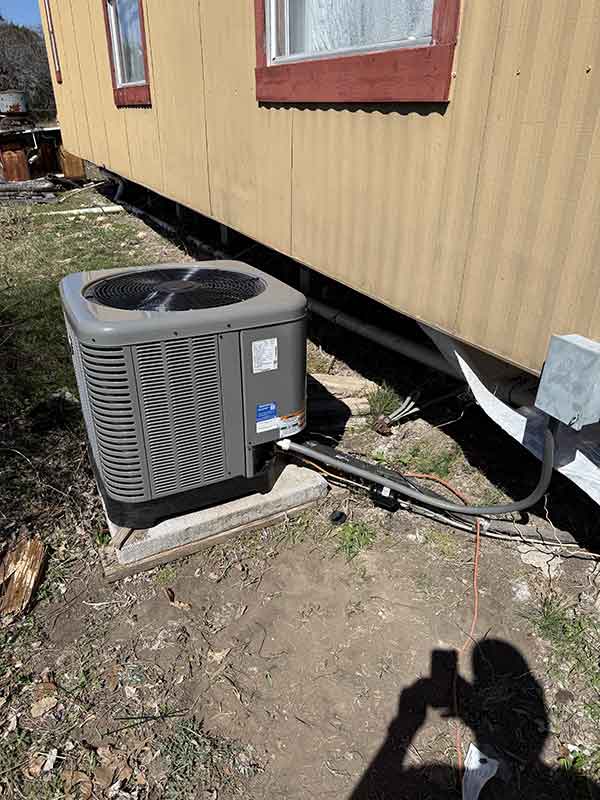
One part fails more often than everything else combined, and it costs less than a tank of diesel. The run capacitor is a little cylinder that gives the compressor and the fan motor the shove they need to start turning. Heat kills it, and an outdoor unit sitting in full Texas sun for five months is exactly the wrong place to ask a capacitor to live. The symptom most Leander callers describe is the same: the outside fan is not spinning, or it hums and quits, or the house cools fine until the hottest hour and then gives up. A tech reads the capacitor with a meter, sees it has drifted well below its rated microfarads, and swaps it. Ten minutes, one part, and the system runs. Its cousin the contactor, the electrical switch that closes every time the thermostat calls, pits and welds from the same duty cycle. Both ride every truck.
One number, any hour.
No answering service, no callback queue. The person who picks up can diagnose over the phone.
Any Hour, Any Day
What the Name Actually Means
Something failing is not the same as something being dangerous, and the overnight phone call is where that distinction matters most. There are symptoms we want to hear about immediately, regardless of the hour: a burning or hot-electrical smell, a gas odor anywhere near the furnace, a breaker that trips again after one reset, water actively running where it should not be, or a carbon monoxide alarm sounding. On a gas smell or a CO alarm the instruction is the same and it comes before anything about scheduling: get everybody outside and call the gas utility or 911 first, then call us. There are other symptoms that are genuinely fine to sleep on, a system that cools but runs longer than usual, a noise that is new but steady, a thermostat behaving oddly. A technician on the line can tell the difference in about ninety seconds. That triage is free, and we would much rather give it at 1 AM than read about a house fire.
Why Leander Calls Burnet
The Same Rules on Every Street
There are a couple of things worth doing before the truck shows up. Flip the breaker to the air handler and the outdoor unit off and back on once, check whether the filter is loaded, clear a path to the indoor equipment and unlock the gate if the condenser is fenced. Note what time it quit and what it sounded like. Then call (512) 925-3090, because those details shorten the diagnosis more than people expect.
Two visits a year, and the timing is the part that matters. The cooling visit wants to happen in spring, after the pollen has finished falling and well before the first hundred-degree stretch, because a weak capacitor found in April is a ten-minute appointment and the same capacitor found in July is a no-cool call at nine at night. The heating visit belongs in fall, ahead of the first front, since a furnace that has sat idle since March will tell you on its first ignition whether the igniter and flame sensor made it through the summer. Miss those windows and you are competing with everybody else who missed them, which is why the spring and fall calendar fills early and late callers wait. Two appointments. That is the whole commitment, and it is the difference between a system that gets serviced and a system that gets discovered.
Nearby in Williamson County
Neighbors on the Same Map
One route covers the whole county: Cedar Park · Georgetown · Round Rock · Hutto · Taylor · Liberty Hill · Jarrell · Florence · Thrall · Granger · Coupland · Bartlett · Weir. County page: Williamson County. Recent jobs from this stretch of the map are in the gallery.
Leander Questions
What Neighbors Ask First
Every house on our street seems to have the same AC problems. Why?
Production building synchronizes everything: your street’s homes likely share a builder, a duct design, an equipment package, and an installation season, so the failure calendar runs in lockstep, the same capacitors aging out the same summer, the same undersized returns starving the same rooms, the same upstairs complaint in every two-story of your floor plan. We keep pattern files by subdivision where the work accumulates, which often pre-informs your diagnosis before the truck arrives. The upside: fixes proven three doors down are proven for you, and the corrections are known quantities rather than experiments.
Is it worth fixing builder-grade equipment or should we upgrade early?
Run the honest math, not the sales pitch: builder-grade systems respond well to maintenance and deserve repairs while young, and the real question is trajectory, repair frequency, efficiency gap, and remaining life against replacement cost, which we lay out with real numbers when the question arises. What the eventual replacement buys in this housing stock is more than equipment: the load calculation the builder skipped, duct corrections made while the system is open, and right-sizing that fixes the clammy-at-74 oversizing signature. Until that day earns itself, maintain what you have and bank the difference.
How fast can you reach Leander from Burnet?
The 183 corridor is a standing weekly route, not an occasional trip: Leander anchors our Williamson runs, service clusters make the drives efficient, and windows get quoted with honest corridor math per the standing policy. Same-week scheduling is routine, emergencies get the on-call truck at truthfully-stated windows around the clock, and the growing Leander file keeps the trucks familiar with every phase of every subdivision. The drive is real and priced into nothing; the honest window is the whole promise.
Do you charge extra to come out here?
Distance is part of the visit cost and you hear the exact number on the phone before any truck rolls, which is the whole pricing policy in one sentence. No mileage surprises on the invoice, no geography premium beyond the honest drive. For larger projects, installs and replacements, travel typically washes out entirely, and we say so when we quote. The price you hear first is the price.
How fast can you get here in an emergency?
The 24-hour line answers with a real tech at any hour, emergencies jump the schedule, and the window quoted reflects the honest drive from Burnet or wherever the truck currently sits. No-cool and no-heat calls with vulnerable people in the house go first, always. What you never get is a promised fifteen minutes that becomes three hours; the window stated is the window kept.
Leander, You Are on the Map.
Repairs, replacements, and the 24-hour line, all from one Burnet shop. Send the form or call any hour.
(512) 925-3090 Book a Free Look




