
Manufactured Homes Are Not Small Site-Built Houses
A fair amount of what we service around Marble Falls and the surrounding county is manufactured or modular, and it gets treated by the trade as though it were simply a smaller version of a stick-built house. It is not. The heating and cooling in these homes is engineered differently at almost every point, and advice that is perfectly sound for a house on a slab can be actively wrong here.
None of this is a knock on the housing. It is good, sensible housing, and plenty of it is better maintained than the site-built stock. But the equipment, the duct layout and the airflow assumptions are their own thing, and hiring somebody who does not know that is how people end up with a comfortable living room and a bedroom nobody uses in August.
The Ducts Run Under You, Not Above You
The single biggest structural difference is where the air goes. A site-built house here almost always runs its ductwork through the attic. A manufactured home usually runs a single main duct down the belly of the home, under the floor, with floor registers branching off it. That changes everything downstream of it.
The belly duct lives inside a wrapped cavity under the floor, protected by what the industry calls the belly board or bottom board. When that wrap is intact, the duct is in a reasonably protected space. When it is torn, and after a couple of decades and a few plumbing repairs it very often is, the duct is effectively running through open air under the home. Animals get in. Insulation sags away. Conditioned air leaks into the crawl space, and on the return side outside air gets pulled in.
We find torn belly wrap on a large share of the older homes we open up, and it is usually the explanation for a comfort complaint that three previous companies attributed to the equipment.
The Return Is Usually One Opening
Site-built houses increasingly get returns in multiple rooms. A manufactured home typically has one central return, often a grille in a hallway wall near the furnace closet. That works when interior doors are open and fails quietly when they are closed, because a bedroom with a supply register and no return path pressurizes slightly, which chokes off the air trying to enter it.
The room then runs warm in summer and the homeowner concludes the system cannot reach it. The fix is frequently as small as undercutting a door or adding a transfer path, and it costs almost nothing compared to the equipment quote that often gets written instead.
The Equipment Itself Is Rated Differently
Air handlers and heating equipment installed in manufactured housing are supposed to be units listed for that use, and there are real reasons for it: sealed combustion drawing air from outside rather than from the home, specific clearances for the closet they sit in, and a duct connection designed for that belly layout. A standard residential unit dropped into a manufactured home closet because it was on the truck is not an equivalent substitution.
That swap turns up in the field, sometimes after running for years. It is still worth knowing about, because it affects combustion safety, it affects whether the installation meets the listing, and it can affect what an insurer or an inspector says about the home later.
Sizing Gets Distorted in Both Directions
These homes generally have less thermal mass and different envelope construction than a site-built house of the same square footage, which means they respond faster to outdoor conditions in both directions. Warm afternoons load them up quickly and clear nights cool them off quickly.
The instinct is to answer that with more capacity. It is usually the wrong instinct, because oversized equipment in a small tight volume satisfies the thermostat almost immediately, shuts down, and never runs long enough to pull moisture out of the air. In this humidity, near this lake, that produces a home that hits its setpoint and still feels damp and sticky. Right-sizing matters more here, not less.
The Condensate Path Is Shorter and Less Forgiving
Every cooling system pulls water out of the air, and that water has to get somewhere. In a site-built house the drain usually has a long run with room for slope and a secondary path if the primary clogs. In a manufactured home the run is typically shorter, tighter and more exposed, and the margin for a lazy install is smaller.
Near this lake the humidity means the system is producing water most of the season, and biological growth in a drain line is a matter of when rather than whether. A clog in a short exposed line backs up quickly. That is why we want to see a proper trap where the design calls for one, real slope on the run, and a safety switch that shuts the system down rather than letting the pan overflow into the floor. It is a small part of the job that prevents a genuinely expensive kind of damage.
What We Check First
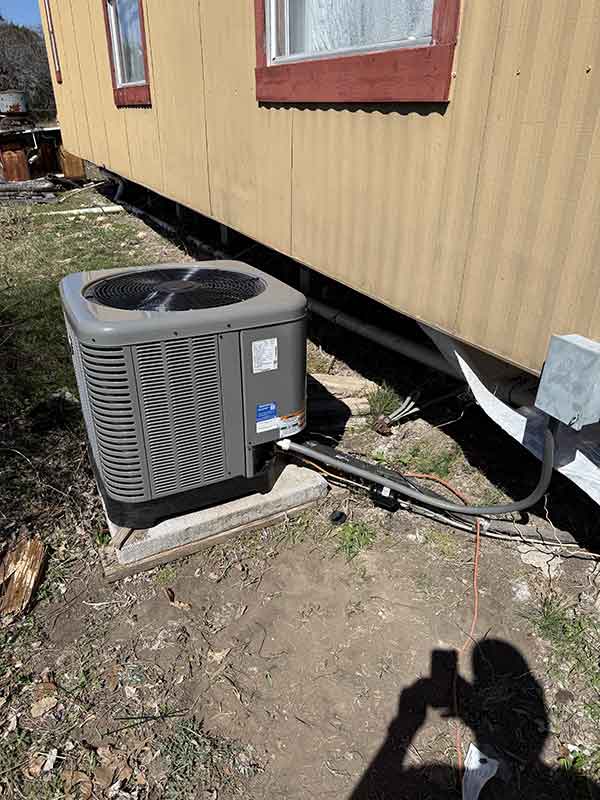
The belly wrap and the condition of the main duct under the home, because that is where the recurring problems live. The return path, and whether closed bedroom doors are strangling the rooms that complain. Whether the equipment is listed for manufactured housing and whether the closet clearances are what the listing calls for. The condensate path, which in these homes often has a shorter, more exposed run than it would in a site-built house. And the ground under the unit outside, because settling here is real and a condenser that has tilted is not draining or running the way it should.
That is a different opening checklist than we would use on a house in a subdivision, which is the whole point.
Can any HVAC company work on a manufactured home?
Most can perform basic service, but the layout knowledge is what separates a real diagnosis from a guess. The belly duct, the single central return and the listing requirements on the equipment are specific to this housing, and a company that mostly works on site-built homes may read a duct problem as an equipment problem. Ask whether they have opened the belly on one before.
Our back bedroom never cools down. Is the unit too small?
Very often it is not. In a home with one central return, a closed bedroom door pressurizes the room slightly and blocks the supply air trying to get in, so the room runs warm while the rest of the home is fine. Undercutting the door or adding a transfer path solves a surprising number of these. That is worth ruling out before anybody quotes equipment.
What is belly wrap and why does it matter so much?
It is the protective barrier under the floor that encloses the main duct and the insulation. Intact, it keeps the duct in a reasonably sheltered space. Torn, which is common on older homes and after plumbing work, it leaves the duct exposed, lets insulation sag away, invites animals in, and turns supply and return leaks into a constant loss. It is one of the first things we look at.
Can we put a standard home furnace in a manufactured home?
It should be a unit listed for manufactured housing, and that is not a formality. Those units are built for sealed combustion, specific closet clearances and the duct connection this housing uses. We do find standard residential equipment installed in these closets, and while it may have run for years, it is worth knowing about for combustion safety and for how an inspector or insurer may treat it.
Is a mini-split a good option for a manufactured home?
It can be, particularly where the belly duct is at the end of its life or where only part of the home gets used regularly. Ductless equipment sidesteps the belly entirely, runs efficiently at low output, and gives individual rooms their own control, which addresses the single-return problem directly. Whether it beats repairing the ducted system depends on the condition of what is already there.
Have It Looked at by Somebody Who Knows the Layout.
The belly, the return path, the closet and the listing on the equipment. One measured assessment reads all of it and tells you whether this is a duct problem, an airflow problem or genuinely the machine.
Call (512) 925-3090or request a call backBrowse real jobs in the gallery, or read about how we size a replacement and what we look at on heat pumps.